
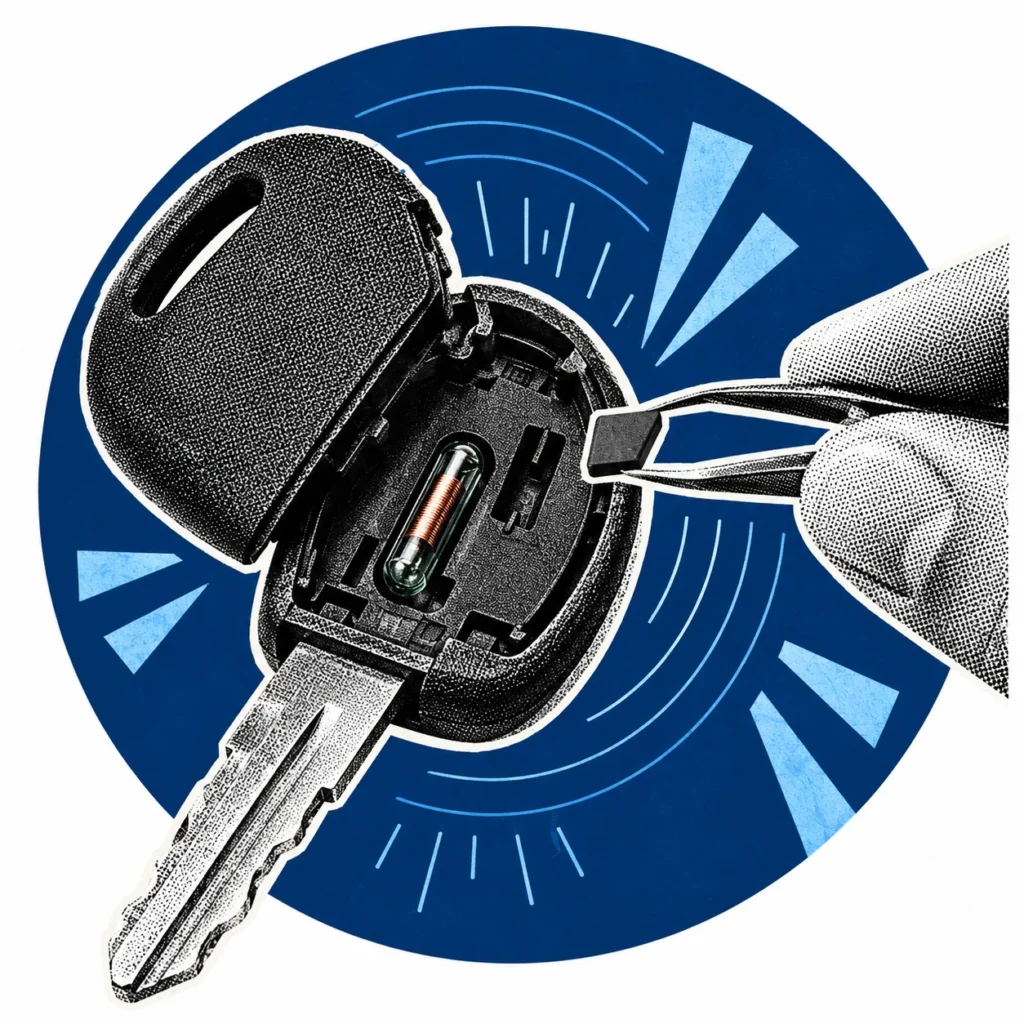
A transponder chip is the electronic identity chip inside a vehicle key. Choosing the right transponder chip means checking the vehicle system, the chip family and the intended operation together. The wrong chip can stop the vehicle from starting, even if the key fits the lock perfectly.
How does a transponder chip work?
Transponder chips work without a battery. When the ignition is switched on, the antenna around the ignition powers the chip with a low-frequency signal, and the chip sends back its identity data. This technology is based on the same principle as RFID. The immobiliser compares the incoming data with the registered keys and allows the engine to start if there is a match.
This working principle shows why selection is not just a matter of physical fit. The chip must belong to the family the vehicle expects and be in a suitable state for the operation.
Identify the transponder chip family
The type and status information on the transponder reading screen is the starting point for selection. Fixed-code and crypto families have different characteristics. Sub-types within the same family may not be directly interchangeable either.
Do not check the chip number alone; check the target vehicle, the current state of the key and the operation you plan to perform together. Do not assume that a transponder that can be read can necessarily be cloned or rewritten.
Blank chips and pre-coding
In some applications, a blank transponder is prepared to suit the relevant vehicle system before it is added to the vehicle. This pre-coding step is not the same as registering the key with the vehicle. The chip used must be a type supported by the preparation application.
Use current application information
IEA’s transponder update notes list reading, identification, generation and cloning operations separately. Support added for one function does not mean that every other function is supported too. Review the version on your device together with the relevant update note.
Common mistakes when choosing a transponder chip
The most common mistake is selecting a chip based only on the appearance or shell of the key; different chip families can sit inside the same shell. Your choice of transponder chip should always be based on the reading result and the vehicle information.
Another mistake is assuming that a chip that is not suitable for cloning can be rewritten. Whether a chip is locked or already registered to a vehicle can change the outcome of the job. If you are unsure, note the status information on the reading screen before you start.
Fixed-code vs. crypto transponders
Fixed-code transponders send the same identity data every time they are read. This design is common in older immobiliser systems, and cloning with suitable chips is relatively straightforward. Crypto transponders, on the other hand, run an encrypted challenge-response exchange with the vehicle, so cloning or adding keys requires more preparation.
With crypto families, some operations may require additional data to be collected from the key or the vehicle. This difference explains why the chip family is the first thing to check when choosing a transponder chip.
Quick transponder chip checklist
- Vehicle make, model, year of manufacture and immobiliser system
- Chip type and status shown on the reading screen
- Operation to perform: cloning, pre-coding or adding the key to the vehicle
- Device version and the relevant update note
Where the chip sits by key type
In traditional chip keys, the transponder chip usually sits in a slot inside the key head. In flip keys and remote keys, the chip may be mounted on the remote board or housed in a separate compartment inside the shell. In smart keys, the transponder function is often integrated into the remote circuit; these keys need a suitable remote board and a key-adding procedure rather than a separate chip.
Understanding the key’s construction before you open it avoids unnecessary part replacement and damage to the shell. When buying a spare transponder chip, also check that its physical size fits the slot in the shell.
Frequently asked questions
What should I look at when choosing a transponder chip?
Assess the vehicle make, model and year, the immobiliser system, the chip family and the planned operation together. Comparing the reading result with the current application list makes the choice clear.
Can every transponder be cloned?
No. Some chips are suitable for cloning, while others can only be used by adding them to the vehicle. With crypto families, support varies with the chip type and the scope of the application.
Can a blank chip be added directly to the vehicle?
On some systems, yes; on others, the chip first has to be prepared through pre-coding. The vehicle system and the application used determine which route to follow.
What happens if the wrong transponder chip is chosen?
An incompatible chip cannot be added to the vehicle, or the cloning cannot be completed. In that case the engine will not start, even if the key fits the lock. Before using a new chip, check the reading result and the application scope again.